





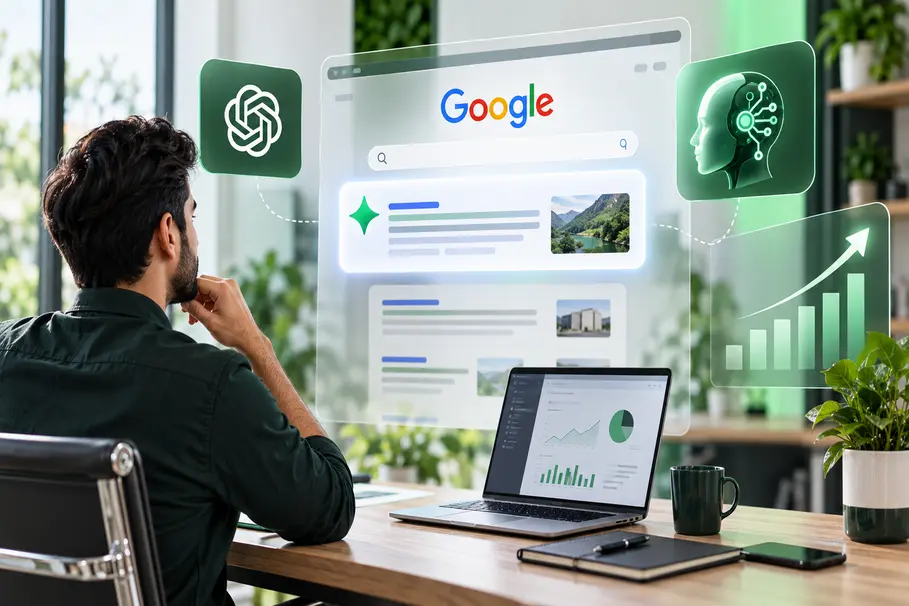
If you stepped away from Google Ads for a year and came back this September, you’d recognize the furniture but not the layout. Keywords still exist. Budgets still exist. You still write ads and count conversions. But the platform is quietly handing more and more of the day-to-day decision-making to its own AI — and it’s doing it on a schedule, whether you opt in or not.
That’s not a knock on Google. It’s a strategic bet, and it’s worth understanding why the company is making it before we get into the mechanics. Because once you understand the pressure Google is under, the changes stop looking random and start looking inevitable.
The old question in paid search — “How much can I control by hand?” — is mostly answered now. The better question for 2026 is: how well can you point Google’s automation at the customers who are actually worth having?
Here’s what changed, and what to do about it.
Why Google Is Going All-In on AI Advertising
For most of the last two decades, Google Search was the front door to the internet, and Google Ads was the toll booth. That position is no longer unchallenged.
Two things are squeezing the business at once. First, the competitive field. eMarketer projected that Meta would overtake Google in total digital ad revenue for the first time in 2026 — a milestone that would have sounded absurd a few years ago. Add Amazon’s retail media machine, Microsoft’s Copilot-powered ads in Bing, TikTok, and the sprawl of retail media networks, and Google is fighting for budget it used to win by default.
Second, and more fundamentally, search behavior itself is shifting. People increasingly get answers from AI-generated summaries and chat-style assistants instead of scrolling a page of blue links. When queries get longer, messier, and more conversational, the tidy keyword lists advertisers spent years building start to miss a lot of real demand. Google has more or less said this out loud: landing-page-based matching alone isn’t enough to keep up with how people search now.
So Google’s answer is to let its models do the matching, the asset creation, and the bidding — and to sell that as a feature rather than a loss of control. For advertisers, the practical takeaway is simple. The automation is coming regardless of how you feel about it. Your job is to steer it, not to fight it or ignore it. (If you’d rather hand the steering to specialists, that’s exactly what our Google Ads management services are built for.)
AI Max Is Now the Default for Search
The single biggest change is AI Max for Search. It came out of beta in April 2026, and Google now enables it by default when you create a new Search campaign.
AI Max isn’t a separate campaign type sitting next to your others. Think of it as an automation layer bolted onto Search campaigns: AI-driven search-term matching, automatically generated and customized assets, and machine-selected landing pages, all working on top of your existing structure. Google’s own numbers claim campaigns using the full feature set see roughly 7% more conversions or conversion value at a similar CPA or ROAS versus using search-term matching alone. Treat vendor stats with the usual pinch of salt, but the direction is clear enough.
What AI Max Actually Does
Under the hood, AI Max can:
- Expand which search terms your ads show for, beyond your keyword list
- Generate and tweak headlines and descriptions to fit the query
- Swap in landing pages via final URL expansion
- Target by location of interest, not just physical location
- Apply brand controls, URL inclusions, and URL exclusions
- Report on which search terms, assets, and pages the AI is contributing
Crucially, Google has kept building controls alongside the automation. You can now give natural-language instructions about language, claims, or concepts you want the AI to steer clear of — a real acknowledgment that “let the machine write it” without guardrails is a bad idea for most brands. The controls are the point. AI Max without oversight is just spending your budget faster.
The DSA Sunset: The Timeline That Actually Matters
If you’re still running Dynamic Search Ads, mark your calendar. Google originally wanted everything folded into AI Max by September 2026, then extended the DSA deadline after advertisers pushed back about disrupting Q4. Here’s where it stands:
- June 15, 2026 — Google restored the ability to create and edit DSA campaigns (it had briefly frozen this).
- September 2026 (now) — Campaigns using Automatically Created Assets (ACA) or the campaign-level broad match setting are being auto-upgraded to AI Max this month. This wave is rolling out as you read this.
- January 2027 — You can no longer create new DSA campaigns anywhere: UI, Editor, or API.
- February 2027 — Full auto-migration. Any remaining DSA campaign is upgraded automatically.
One reassuring detail that a lot of panicky posts skip: if your Search campaigns use standard responsive search ads with keyword-level match types (broad, phrase, exact) and you haven’t switched on ACA or campaign-level broad match, nothing happened to you on September 1. Those campaigns keep running as-is. The September wave only touches the legacy automated settings.
The advice writes itself: don’t wait for the forced move. Audit your DSA campaigns, search terms, landing pages, negatives, and conversion tracking now, and migrate on your own terms so you understand the new controls before Google flips the switch for you.
Smart Bidding Changed Under the Hood
Two things happened with Smart Bidding this year, and one of them will quietly cost people money if they missed it.
The cosmetic change: in mid-2026 Google simplified some strategy names. “Maximize conversions with a Target CPA” is now just Target CPA, and “Maximize conversion value with a Target ROAS” is now Target ROAS. Same behavior, cleaner labels. Nothing to do here.
The one that matters: on August 17, 2026, Google changed how target-based bidding behaves for campaigns that are limited by budget — and this is now live, not a warning about the future.
What This Means, In Plain English
For years, budget-capped campaigns quietly overperformed their targets. You’d set a $10 Target CPA and the system would often deliver at $5, because a constrained budget forced extra efficiency. Nobody complained, so nobody updated their targets.
That’s over. Now a budget-limited campaign will drift toward the target you actually entered. If your $10 tCPA campaign has been quietly hitting $5, it will start moving back up toward $10 unless you do something. Google isn’t resetting your targets or raising bids — it’s just taking the number you typed in literally.
The change covers Search, Shopping, Performance Max, Demand Gen, and Travel. Display and Hotel already ran this behavior; App, Video reach, and Video view campaigns are unaffected. Google shipped a Bid Target Adjustment Tool (live since July 6) that shows your recent performance and lets you reset targets to match it.
What to Check Right Now
If you never touched the Bid Target Adjustment Tool before mid-August, go look at your budget-limited, target-based campaigns and confirm your targets still reflect the performance you actually want. Then keep an eye on spend, conversion volume, CPA/ROAS, and impression share for a few weeks. The old advice holds harder than ever: don’t set a target and walk away.
Performance Max: Scale Is Easy, Judgment Isn’t
Performance Max is still central to Google’s automated ecosystem, and it’s still genuinely useful when you want to find volume across Search, Shopping, YouTube, Display, Gmail, and Maps without micromanaging each one. It’s also gained more automatically generated imagery and stronger video capabilities from Google’s newer models.
The trap is measuring it by conversion count. More conversions is not the same as better advertising. If your feedback loop tells Google that every lead is equally valuable, PMax will happily manufacture more of your worst leads.
Judge it on the things that reflect the health of your business:
- Revenue and profit, not just conversions
- New versus returning customers
- Conversion quality — how many of those leads actually close
- Which asset groups, search categories, and geographies are pulling their weight
PMax rewards good measurement and punishes lazy measurement. That’s the whole game.
Shopping and Commerce Get More Conversational
For ecommerce, Google is pushing AI deeper into product discovery — more conversational, personalized ways for shoppers to explore products, built on its Gemini models. The interface is getting smarter about surfacing the right item to the right person.
Which puts even more weight on the least glamorous part of retail advertising: your product feed. AI can optimize how and where a product shows up, but it can’t paper over bad data. Titles, descriptions, images, prices, availability, categories, brand, GTINs, shipping — get these right and the automation has something to work with. Get them wrong and you’re just automating your mistakes at scale.
Display Is Turning Into Demand Gen
If you’ve run Display or the old Discovery campaigns, expect them to keep folding into Demand Gen, with eligible advertisers getting migration options through 2026.
Demand Gen is built for visually rich, discovery-style placements — people encountering your brand while they’re consuming content, not while they’re actively searching for a fix. That’s a different mindset from high-intent search, and it needs different creative. Somebody Googling “emergency plumber near me” and somebody scrolling YouTube Shorts are at opposite ends of the funnel. Feed them the same ad and you’ll disappoint both.
Local and Service Businesses Need Their Own Playbook
If you run a trade or a local service — plumbing, electrical, dental, legal, HVAC, cleaning, a salon — standard Search campaigns are only part of the picture.
Local Services Ads let eligible businesses appear at the very top for relevant local searches, often on a pay-per-lead basis, and they behave quite differently from a normal Search campaign. But the ads don’t work in a vacuum. Your Google Business Profile, your reviews, accurate service-area info, and fast, trustworthy local landing pages all feed into whether a searcher actually picks you.
It’s worth being precise about terms here, because they get muddled constantly. “Google Maps ads,” “Google My Business ads,” and “local Google Ads” get used interchangeably, but Business Profile visibility, Local Services Ads, and location-based Search advertising are three different things. A real local strategy treats the whole journey as one system:
search → Business Profile or map → website or phone call → lead → customer.
Keywords and Negatives in an AI-First Account
Keywords aren’t dead — but the days of building a ten-thousand-line keyword sheet as your core strategy are. Google’s matching is now good enough to reach intent your list never anticipated, which means keyword research with tools like Keyword Planner is best used for understanding demand and themes, not as the campaign itself.
Start narrow and let automation widen it: your highest-value products or services, genuinely high-intent queries, the problems customers are trying to solve, and your real conversion data. Then let AI find the adjacent opportunities.
And do not sleep on negative keywords. When your campaigns are actively expanding into new queries, negatives become more important, not less. A premium service business almost certainly wants to exclude terms tied to “free,” “jobs,” “careers,” “DIY,” “templates,” “cheap,” and so on. Your job isn’t to stop Google from exploring. It’s to stop it from spending your money on searches that will never turn into customers.
Conversion Tracking Is the Real Lever Now
Here’s the thing most advertisers underrate. As Google takes over more of the decision-making, your conversion tracking data becomes the steering wheel. Feed it bad signals and it will confidently optimize toward the wrong outcome.
Picture a campaign that generates 100 leads, of which 8 become customers. If Google thinks all 100 are equally valuable, it will chase more of all of them — including the 92 that go nowhere. Value-based signals fix this. Tell the system which conversions actually matter — purchases, qualified leads, booked calls, high-value form fills, revenue, customer acquisition value — and it optimizes toward outcomes instead of vanity.
With third-party cookies still a moving target and privacy tightening, first-party data, enhanced conversions, and proper consent handling have quietly become table stakes for anyone serious about performance. Better data in, better decisions out. It’s not glamorous, but it’s the highest-leverage work in the account.
What Good Google Ads Management Looks Like in 2026
Put it all together and the job has changed shape. Managing Google Ads used to mean adjusting hundreds of bids and match types by hand. Now it means managing the system around the automation — and that’s arguably a harder, more strategic role.
A strong practitioner today is fluent in six things:
- Strategy — what to advertise, to whom, where, and why.
- Data — which conversions and customers genuinely matter.
- Automation — which of Google’s AI features to actually switch on.
- Control — what to let the AI expand, and what to keep on a short leash.
- Creative — the messaging and assets that represent the brand honestly.
- Measurement — whether all of this is producing profitable growth or just activity.
If you’re auditing an account with fresh 2026 eyes, the checklist is short: kill outdated campaign types and legacy DSAs before Google does it for you; confirm your conversion tracking actually knows what a good customer looks like; test AI Max deliberately in controlled experiments rather than flipping everything at once; keep reading your search-term reports; and stop optimizing for cheap clicks. The hierarchy that matters runs relevant click → qualified lead → customer → revenue → profit — not “clicks.”
The Bottom Line
Google Ads in 2026 is unmistakably AI-first. AI Max is now the default for Search. Smart Bidding quietly changed how it treats your targets. Performance Max keeps expanding. Shopping is getting conversational. Display is becoming Demand Gen. And Google is under real competitive pressure — from Meta, Amazon, and the shift toward AI-driven search — that explains why it’s moving this fast.
None of that makes good advertising less valuable. It makes good strategy more valuable. The winners in 2026 won’t be the accounts with the biggest budgets. They’ll be the ones that understand their customers, feed the system clean conversion data, use automation with intent, fence off the traffic that doesn’t convert, test relentlessly, and measure what actually grows the business.
Google’s AI is very good at scale. It’s still terrible at knowing your margins, your best customers, or the leads you secretly hate. That part is yours. So the question worth asking heading into the rest of the year isn’t “how do I get more clicks?” It’s “how do I use Google’s technology to get more of the right customers?”
That’s the real opportunity — and it’s the one most advertisers are still leaving on the table. If you’d like a second set of eyes on your account before the next migration wave, get in touch for a Google Ads audit.