





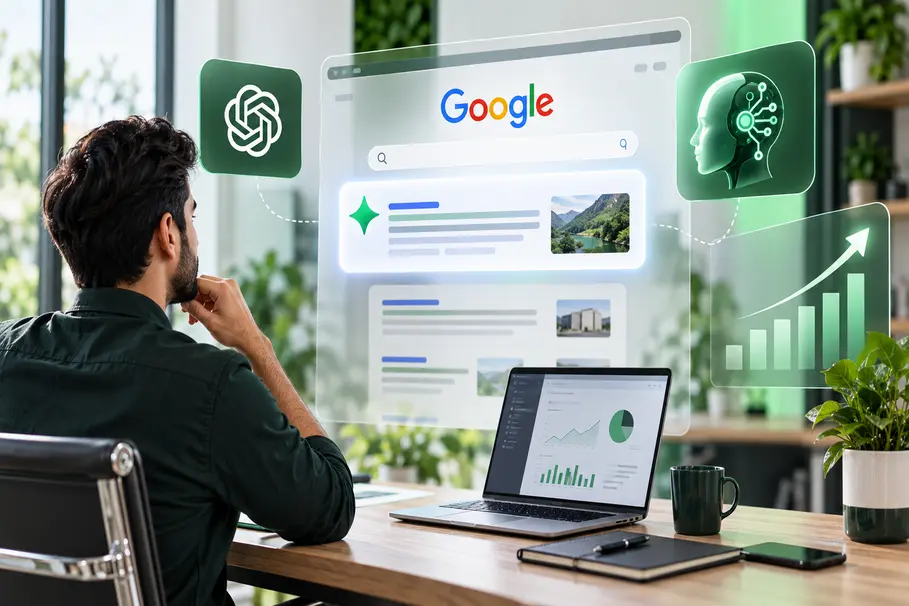
Google Search isn’t just a list of blue links anymore.
These days, you can ask Google a genuinely complicated question and get a written answer right there on the results page — no clicking required. That’s what AI Overviews and the more conversational AI Mode have done. And it’s quietly changing how people find businesses, compare products, and decide who’s worth their attention.
Which leaves a lot of business owners asking the same uncomfortable question:
If Google can answer the question without sending anyone to my website, does SEO even matter anymore?
Short answer: yes. But the job has changed.
Ranking #1 used to be the whole game. Now the real goal is becoming a source that search engines — and the AI systems sitting on top of them — understand, trust, and pull into their answers. Google has expanded its own guidance on optimizing for these generative features, while making a point of saying the fundamentals of SEO still apply. (Google for Developers)
So let’s talk about what’s actually going on, and what’s worth doing about it.
What Are Google AI Overviews?
An AI Overview is the AI-generated response that shows up inside Google Search for certain queries.
Instead of you opening five tabs and stitching the answer together yourself, Google does the stitching. It reads across multiple sources and hands you a summary up top.
Search something like “what’s the best way to improve local SEO for a small business?” and you’ll often see a written explanation before you ever reach the regular organic results.
Here’s the shift that matters: your website can now feed into that answer even when nobody clicks your page. So “visibility” isn’t just about where you rank anymore. It now includes whether you get cited in the overview, whether your brand gets mentioned, whether Google recognizes you as a real entity in your space, and how much topical authority you’ve built around the subject.
What Is Google AI Mode?
AI Mode takes the same idea and turns it into a conversation.
Rather than dropping a summary above your normal results, it gives you a back-and-forth search experience. You ask, it answers, you ask a follow-up, it goes deeper. The old flow was basically question → Google → website. AI Mode looks more like question → AI does the research → you ask follow-ups → it surfaces sources → you decide.
And here’s the part SEOs should sit up for: Ahrefs studied both experiences and found AI Mode responses were noticeably longer and packed with far more entities than AI Overviews. But only 13.7% of citations overlapped between the two in their dataset. (Ahrefs) In plain terms — showing up in one is no guarantee you’ll show up in the other.
AI Overviews vs. AI Mode: How They Differ
They’re cousins, not twins. They answer different kinds of intent.
| AI Overviews | AI Mode |
|---|---|
| Lives inside regular Google Search | A dedicated, conversational search experience |
| Gives a fairly concise answer | Handles deeper, multi-step exploration |
| Summarizes a handful of sources | Can chase a topic across several follow-up questions |
| Built for quick understanding | Built for research and discovery |
| Nudges how people behave on the SERP | Can become the whole search session |
The practical takeaway: don’t assume one strategy covers both. A page that’s perfect for a quick overview might never get pulled into a deeper AI Mode session — and the reverse is just as true.
Why This Actually Matters for Your SEO
The biggest change is that visibility now matters more than ranking alone.
You can sit at the top of the results and still lose clicks, because the AI answer already gave the searcher what they came for. Ahrefs’ 2026 analysis of 300,000 keywords found AI Overviews were tied to a 58% lower average click-through rate for the top organic result. (Ahrefs)
That stat scares people, and I get why. But it doesn’t mean rankings are worthless — it means the question you’re asking is too small. “How do I rank #1?” is fine. “How do I become one of the sources Google trusts enough to use in its answer?” is better.
The New SEO: From Ranking to Getting Cited
Old-school SEO obsessed over position. Modern search optimization has to think about visibility, relevance, authority, and citations all at once.
Picture two sites covering the same topic.
The first one publishes generic 800-word articles, repeats its target keyword a few times, adds nothing original, and gives you no reason to believe a real expert wrote it. The second one shares genuine insight, answers specific questions, shows practical experience, backs its claims with credible sources, and covers the subject properly across several connected pages.
Google’s systems have a lot more to work with on that second site — more signal, more context, more reason to trust it. That’s really the whole game now. Optimizing for AI search isn’t about sprinkling the words “AI Overview” into your copy. It’s about being the site that’s actually worth citing.
How AI Search Changes Keyword Research
Keywords still matter. Keyword lists, on their own, don’t cut it anymore.
AI-powered search understands how questions and concepts relate to each other. So a business chasing “local SEO services” shouldn’t spin up twenty near-identical pages that just reword the phrase. It should build a genuine cluster around the whole subject — Google Business Profile optimization, local citations, reviews, local content, near-me searches, ranking factors, service-area businesses, and how you actually measure any of it.
That’s topical depth, and it beats keyword repetition every time.
The mindset shift is straightforward. Start with what does this person want to know? Then what will they naturally wonder next? And finally what example, data, or first-hand experience would make my answer genuinely useful instead of interchangeable? That’s exactly how conversational search wants to be fed.
Query Fan-Out Is Reshaping Content Strategy
One of the ideas driving all of this is query fan-out — the way AI systems break one complex request into several smaller information needs behind the scenes.
Take “how can I grow my local restaurant without spending money on ads?” An AI might quietly branch that into local SEO, Google Business Profile, reviews, local content, social media, website optimization, competitor analysis, and local search intent — then assemble an answer from all of it.
Which is why covering the whole ecosystem around your topic is so much more valuable now than owning a single keyword. Ahrefs flags query fan-out as one of the defining SEO trends of the year. (Ahrefs)
What AI Search Optimization Actually Looks Like
There’s no magic “AI SEO” button, so ignore anyone selling you one. What you can do is strengthen the foundations that help these systems understand and trust your work.
Answer the Question Right Away
Don’t make people scroll past five paragraphs of throat-clearing. If someone asks “how long does SEO take?”, tell them up front. Then explain what affects the timeline, what to realistically expect, the common mistakes, how progress gets measured, and what the first 90 days tend to look like. Leading with the answer helps humans and search systems alike.
Build Real Topical Authority
One article rarely makes you an authority on anything. If you offer SEO services, your content can span technical SEO, on-page, local, ecommerce, keyword research, content strategy, internal linking, search intent, AI search, algorithm updates, and analytics — each piece reinforcing the others.
This is also where internal linking earns its keep. When your related articles connect naturally, you’re showing search engines how your expertise fits together. For example, if you’re thinking about AI search and local visibility, it’s worth reading our companion piece on building a step-by-step strategy to grow a local business online without paid ads — it walks through the organic tactics (Google Business Profile, reviews, content, social, and website optimization) that give you something local to actually be cited for.
Strengthen Your E-E-A-T Signals
AI systems lean on reliable information, which makes Experience, Expertise, Authoritativeness, and Trustworthiness more important, not less. Show people you actually know the subject: real author bios, first-hand experience, original examples, case studies, client results, transparent company details, credible references, and content you keep current. Don’t just claim you’re an expert — prove it.
Add Something Only You Can Add
Generic content is cheaper to produce than ever, which is exactly why it’s worth less than ever. If a hundred sites say the same thing, why would an AI pick yours?
Give it a reason. Original research, first-hand observations, real client examples, your own data, screenshots, case studies, a framework you built, a genuine opinion. Google’s 2026 guidance specifically calls for non-commodity content when you’re optimizing for generative search. (Google for Developers)
Structure It for Humans First
Good structure helps everyone — clear H2s for major sections, H3s when a point needs breaking down, short paragraphs instead of walls of text, bullets when something’s meant to be scanned, tables when you’re comparing things, and direct answers with the filler cut out. This isn’t about writing for machines. It’s about making genuinely good content easier to follow.
Don’t Ditch Traditional SEO
The idea that AI killed SEO is the myth that won’t die. Google’s own documentation keeps saying established best practices still apply to its generative features. (Google for Developers) You still need crawlable pages, solid technical SEO, sensible keyword and intent alignment, internal linking, genuinely helpful content, good page experience, mobile usability, structured data where it fits, clean site architecture, and quality backlinks and mentions. AI search didn’t replace the job. It expanded it.
Think Past Your Own Website
Your site isn’t the only place your brand shows up. These systems encounter you all over the web — industry publications, reputable directories, YouTube, social platforms, review sites, business profiles, community threads, partner sites, press coverage, author profiles.
That matters more than it used to. Ahrefs found a meaningful share of pages cited in AI Overviews didn’t come from the traditional top 10 at all, with YouTube turning up as a notable citation source. (Ahrefs) The lesson is simple: build authority beyond your own domain.
Fewer Clicks Doesn’t Always Mean Less Value
Most of the AI-search conversation fixates on lost traffic, and fair enough — if Google answers the question, some people genuinely never click.
But showing up inside that answer still does something. Someone spots your brand in an AI response, recognizes the name, keeps researching, searches for you directly a little later, lands on your site, and eventually becomes a customer. The click didn’t vanish — it moved further down the journey. Clicks still matter. They’re just not the whole story anymore, and your measurement has to catch up to that.
How to Measure SEO in 2026
Stop staring only at keyword rankings. Watch a wider set of signals.
Keep tracking the classics — organic traffic, rankings, CTR, conversions, revenue, backlinks. But add the AI-visibility layer alongside them: how often you appear in AI Overviews, how many citations you’re earning, brand mentions, AI Mode visibility, which URLs get cited, which queries trigger AI features at all, branded search volume, and the quality of the conversions coming through.
Encouragingly, this is getting easier to actually see. Google rolled out dedicated generative-AI performance reporting in 2026 that can surface impressions from AI Overviews and AI Mode, broken out by URL, country, device, and date. (Search Engine Journal) AI visibility is becoming measurable rather than a matter of faith.
Search Isn’t Only Google Anymore
Worth naming plainly: people no longer do all their research on Google. They’re asking AI assistants to compare products, vet businesses, and recommend software directly.
So SEO is quietly folding into something larger — visibility across traditional search and AI-powered discovery. The brands that win won’t be the ones publishing the most content. They’ll be the ones consistently offering useful, credible, recognizable information wherever people happen to be looking.
Seven Practical Ways to Get Ready
If you want a place to start, work through these roughly in order:
- Audit what you’ve already got. Find the pages that are thin, outdated, repetitive, or offering nothing original.
- Build topic clusters. Connect related articles around your core services and expertise.
- Fix your internal linking. Help people and search engines see how your content fits together.
- Add first-hand experience. Real examples, case studies, processes, results.
- Grow authority off-site. Earn relevant mentions and references beyond your own domain.
- Optimize for real questions. Answer the things your customers genuinely ask, clearly.
- Track AI visibility. Don’t lean on rankings and traffic alone.
The Biggest Mistake to Avoid
It isn’t “failing to optimize for AI.” It’s writing for the machines and forgetting the humans who actually need the information.
You don’t need robotic phrasing, stuffed keywords, or awkward sentences engineered to game a model. You need something worth citing — useful information, real expertise, clear structure, genuine authority, and an experience people don’t resent. That’s the version that lasts.
SEO Isn’t Dead — It’s Getting More Valuable
AI Overviews and AI Mode are changing how people search. They aren’t ending the need for quality websites; they’re changing what “visibility” means.
The old path was rank → get the click → convert. The new one looks more like get discovered → get understood → get cited → build trust → earn the click → convert — and sometimes the very first time someone meets your brand, it happens entirely inside an AI answer.
So don’t treat these features as a replacement for SEO. Treat them as its next chapter. The fundamentals hold: make useful content, understand intent, build authority, tighten your website, deliver real value. There’s just one more question worth keeping in front of you this year:
When an AI answers your customer’s question, will your brand be part of the answer?
That’s the problem modern SEO actually has to solve.
Frequently Asked Questions
What are AI Overviews in Google Search?
They’re AI-generated responses that can appear inside Google Search, summarizing information from several sources to answer a query directly on the results page.
What is Google AI Mode?
It’s Google’s conversational search experience, letting you explore a topic through deeper, multi-step follow-up questions instead of relying only on the traditional results.
Do AI Overviews replace traditional SEO?
No. Google continues to state that established SEO best practices still apply to its generative search features. (Google for Developers)
Can SEO help my site show up in AI Overviews?
It can, though there’s no guaranteed formula. Strong technical SEO, helpful and original content, topical relevance, authority, and a clear structure all improve your odds of becoming a source Google uses.
Is AI Mode the same as AI Overviews?
No. They’re separate experiences, and research shows they cite very different sources — so appearing in one doesn’t mean you’ll appear in the other. (Ahrefs)
Will AI search cut my website traffic?
It can. AI answers sometimes satisfy the searcher without a click, and studies have found meaningful CTR drops linked to AI Overviews — though the impact varies a lot by query. (Ahrefs)
Should I stop caring about keyword rankings?
No. Rankings still matter; just pair them with broader signals like AI citations, brand mentions, conversions, and engagement.
How do I optimize my website for AI search?
Start with solid technical SEO, then focus on helpful and original content, clear topical coverage, internal linking, credible sources, first-hand expertise, off-site brand authority, and content that answers real questions directly.
Related reading: Step-by-Step Strategy to Grow a Local Business Online Without Paid Ads